
The Mold Remediation Process
Six stages, each with an exit condition. We do not move to the next one until the current one is met, and the whole sequence is documented so you can see what was done and why.
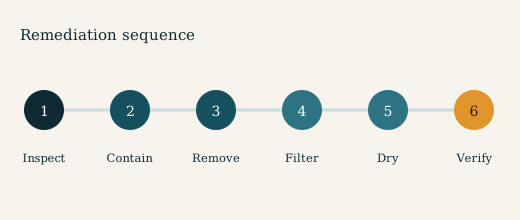
The six stages
Identical on every project, from a single bathroom wall to a flooded lower level. Scale changes; sequence does not.
Inspection and moisture mapping
Moisture meters, thermal scanning and cavity inspection establish how far the problem extends and where the water came from. Readings on affected and unaffected materials give a documented baseline before anything is touched.
Containment under negative pressure
Polyethylene barriers, zipper access and negative air machines isolate the work area so spores are not carried into clean parts of the property. HVAC serving the area is isolated at the same time.
Removal of colonised material
Porous material that cannot be verified clean is cut back to sound substrate along a documented line and double-bagged out through a sealed route. Semi-porous surfaces are cleaned and abraded rather than removed.
HEPA filtration and cleaning
Air scrubbers run throughout the work and through final cleaning. Surfaces are HEPA vacuumed and treated with EPA-registered antimicrobial products appropriate to the substrate.
Structural drying
Air movers and low-grain refrigerant dehumidifiers dry framing, subfloor and masonry. Moisture content readings are logged daily and equipment stays until the numbers converge with an unaffected reference area.
Verification and documentation
A final visual inspection plus moisture readings confirm the area meets a dry standard. You receive the readings, the affected-area mapping, photographic records and the written scope of work.
Equipment we use and what each one does
Remediation is a measurement discipline as much as a removal one. These are the tools that produce the numbers the project is run on.
| Equipment | What it does |
|---|---|
| Pin and pinless moisture meters | Measure moisture content inside building materials and establish the dry standard against an unaffected reference area. |
| Thermal imaging camera | Identifies temperature anomalies that indicate concealed moisture, so inspection openings are made where they are needed rather than speculatively. |
| Negative air machine | Maintains pressure differential inside containment so air flows in rather than out, and exhausts through HEPA filtration. |
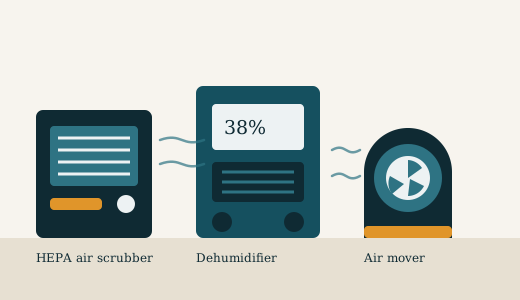
| HEPA air scrubber | Removes airborne particulate during work and through final cleaning, and continues running after removal is complete. |
| Low-grain refrigerant dehumidifier | Removes moisture from the air so evaporation from materials can continue, which is what actually dries a structure. |
| Air movers | Direct high-velocity airflow across wet surfaces to accelerate evaporation into the air the dehumidifier is drying. |
| HEPA vacuum | Removes settled spores and debris from semi-porous and non-porous surfaces before antimicrobial treatment. |
| Hygrometer and psychrometric readings | Track temperature, relative humidity and grains per pound so drying performance can be verified rather than assumed. |
What we document
Every project produces a record. It matters for your own peace of mind, it matters if you are coordinating with an insurance carrier, and it matters at resale when a buyer's inspector asks what was done.
- Initial moisture content readings on affected and unaffected materials
- Affected-area mapping showing the extent and the proposed cut lines
- Source identification with the specific water path that caused the growth
- Photographic evidence through each stage of the work
- Daily moisture logs for the duration of the drying phase
- Final verification readings and the visual inspection record
- Written scope of work describing what was removed, treated and dried
Where our scope ends
We deliver a clean, dry, verified assembly. Reboarding, taping, texture, paint and flooring installation are finish trades. We say so clearly up front, and we tell you what condition the space will be in so the next contractor can plan around it.
Process questions
How long does a mold remediation project take?
A single contained area is typically one to two working days of remediation, with drying equipment remaining a further two to four days. Multi-room projects run three to six days with longer drying. Structural work involving masonry or heavy framing can require seven to fourteen days of drying because dense materials release moisture slowly.
What is negative air pressure and why does it matter?
Negative pressure means air flows into the containment and out through HEPA filtration rather than escaping into the rest of the property. Without it, cutting into colonised material pushes spores through the building. It is the single most important control in the whole process and it is why we never start demolition before containment is built.
What does post-remediation verification actually check?
Two things: that affected materials have reached a documented dry standard, measured against an unaffected reference area in the same building, and that all remediated surfaces pass a visual inspection with no remaining visible growth or residual debris. Both have to pass before an area is signed off.
Do you put the drywall and finishes back?
Our scope ends with a clean, dry, verified assembly. Reboarding, taping, texture and paint are finish trades. We are explicit about where our work stops so nothing falls between the two, and we tell you what the next trade will need from the space before they start.
Ready to get the property assessed?
We walk the affected areas, take readings and give you the scope in writing before any work is scheduled.