
Kitchen Mold Removal in Marietta, GA
Kitchen growth is almost always slow leak damage. A dishwasher gasket, a refrigerator water line, or a weeping supply stop puts a small amount of water into a sealed cabinet base every day for months.
What is kitchen mold removal?
Kitchen mold removal handles growth from under-sink leaks, dishwasher and refrigerator supply line failures, and condensation in cabinet bases. Remediation covers removing colonised cabinet material and toe-kicks, treating framing and subfloor, drying the floor assembly, and confirming the appliance or plumbing source has been corrected.
Kitchen cabinets are built from particleboard and plywood with a finished face and an unfinished, unsealed interior and bottom. A drip that would evaporate harmlessly on a tile floor instead soaks into the cabinet deck, where there is no air movement and no light. Growth establishes inside the cabinet box and under the toe-kick well before anything is visible from the room.
The three sources we find most often in Marietta kitchens are a dishwasher door gasket or drain hose connection, a refrigerator icemaker supply line at the compression fitting, and a sink supply stop that has started to weep at the packing nut. All three produce small, continuous volumes rather than a single flood, which is precisely the condition that favours growth.
Scope depends on how far the water travelled. Confined to the sink base, the work is modest. Where water has run along the subfloor under a cabinet run or under flooring into an adjacent room, the project expands and often involves moldy flooring removal to reach the affected substrate.
Signs you need kitchen mold removal
- Musty smell released when the sink base cabinet door is opened
- Swollen, dark or delaminating cabinet deck or toe-kick
- Buckling or discoloured flooring in front of the dishwasher or refrigerator
- Staining on the ceiling below the kitchen on a lower level
- Peeling cabinet veneer or a soft cabinet base under light pressure
- Rust on the base of the dishwasher or on supply valve bodies
How we handle kitchen mold removal in Marietta
Appliance and supply isolation
Dishwasher, icemaker line and supply stops are checked under pressure to confirm which source is active.
Work-area containment
The kitchen is isolated with barriers and negative air so cabinet demolition does not spread spores through the living space.
Cabinet and toe-kick removal
Colonised cabinet decks, boxes and toe-kicks are removed so the subfloor beneath can be reached and assessed.
Subfloor and framing treatment
Affected subfloor is HEPA vacuumed and treated, or cut out where delaminated, and framing is cleaned.
Floor assembly drying
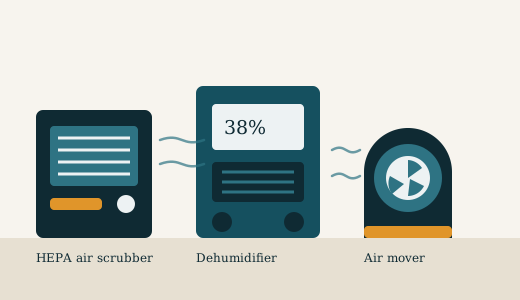
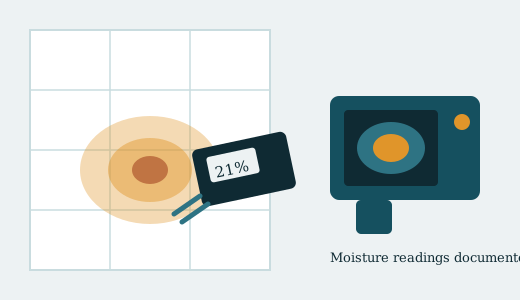
Air movers and dehumidification dry the subfloor and cavity, with readings logged until targets are met.
What gets removed and what gets saved
| Material | Typical outcome | Reason |
|---|---|---|
| Cabinet decks and boxes | Removed where saturated | Particleboard swells irreversibly and holds moisture inside the box. |
| Toe-kick panels | Removed | Toe-kick voids are unventilated and conceal the worst of the growth. |
| Subfloor under cabinet run | Treated or partially replaced | Plywood is cleanable unless ply bond has failed. |
| Solid wood face frames | Usually cleaned | Hardwood frames can be abraded and retained where the box is replaced. |
Moisture source correction is part of the scope
Every project includes identifying the water that caused the growth. Remediating colonised material without correcting the source produces a clean property that fails again in the same place. Where the correction falls to another trade, we document it precisely so the sequence is right.
Kitchen Mold Removal cost in Marietta
Ranges below reflect typical completed projects. Final pricing is confirmed after an on-site evaluation and a conversation about scope.
Sink base only
$700 – $1,500
Typical project range
- Single cabinet base
- Containment and HEPA cleaning
- Subfloor treatment
- Spot drying
Cabinet run and flooring
$1,500 – $2,800
Typical project range
- Multiple cabinets
- Flooring removal in affected zone
- Subfloor remediation
- Dehumidification
Kitchen with adjacent rooms
$2,800 – $4,000
Typical project range
- Water migration beyond kitchen
- Multi-room containment
- Extended subfloor work
- Full verification
These are ranges, not quotes. The figure for your property depends on the affected area, how many assemblies are involved, the material types present, how long the moisture has been active and the drying time the structure requires. We give you a firm number after we have walked the property and taken readings.
Kitchen Mold Removal questions
Can cabinets be saved after a long-running under-sink leak?
Solid wood face frames and doors usually survive and can be cleaned and reused. Particleboard decks and boxes that have swollen or delaminated do not recover, because the compression that holds the board together has been destroyed. We assess each piece individually rather than removing the whole run by default.
How far does water travel from a dishwasher leak?
Further than most people expect. Water follows the flattest path along the subfloor, often running beneath the adjacent cabinet run or under floating flooring into a hallway or dining area. We map the actual extent with meter readings rather than assuming it stops at the appliance.
Do I need to replace my kitchen floor?
Only the portion over affected substrate. Tile set in mortar frequently survives; floating vinyl plank and laminate rarely do once water has reached the core. Engineered wood depends on how long it was wet. We give you the assessment per material before anything is lifted.
Is my kitchen usable while the work happens?
Partially, in most cases. Containment typically isolates the affected cabinet run while leaving the rest of the room accessible. Where the floor assembly is opened across a traffic path, we sequence the work to restore access as quickly as practical.
Related mold services
Moisture problems rarely stay inside one assembly. These are the services most often carried out alongside kitchen mold removal.
- Moldy Flooring RemovalFlooring failure is a layered problem. The finish surface, the underlayment, the adhesive an…
- Water Damage Mold RemovalMold after water damage is a timing failure, not bad luck. Material that stays wet past roug…
- Ceiling Mold RemovalA ceiling stain is the end of the water's journey, not the start. The source is often severa…
- Drywall Mold RemovalDrywall is paper on both faces of a gypsum core. Paper is food and gypsum holds water, which…
View all 20 mold remediation services
Get a firm figure for your property
We walk the affected areas, take moisture readings and give you a written scope with pricing before any work begins.