
Mold Remediation in Marietta, GA
Containment, removal, drying and verified clearance for homes and commercial property across Marietta. We find the moisture source, remove what cannot be saved and prove the structure is dry before we close it up.
What mold remediation in Marietta actually involves
Four things separate a remediation that holds from one that fails within a season.

Finding the water first
Growth is a symptom. We trace the moisture back to a plumbing failure, roof penetration, foundation seepage or condensation path before deciding what comes out. Remediation without source correction fails in the same place.

Containing before disturbing
Cutting into colonised material without containment spreads spores through the property. Sealed barriers under negative air pressure keep the work area isolated from the rooms you are living in.

Drying to a measured standard
Equipment stays until moisture content readings on affected materials converge with an unaffected reference area in the same building. Not until a scheduled end date.

Verifying before closing up
Final readings, a visual inspection of every remediated surface, and a documentation package covering the scope, the readings and the photographic record.

Licensed and insured
A Georgia-licensed and insured remediation contractor using IICRC-certified applied microbial remediation technicians and EPA-registered antimicrobial products.

Documentation that holds up
Moisture logs, affected-area mapping, photographic evidence and a written scope of work — the record your insurance carrier, adjuster or future buyer will ask for.
Our six-stage remediation protocol
The same sequence on every project, from a single bathroom wall to a flooded lower level. Each stage has an exit condition, and we do not move on until it is met.
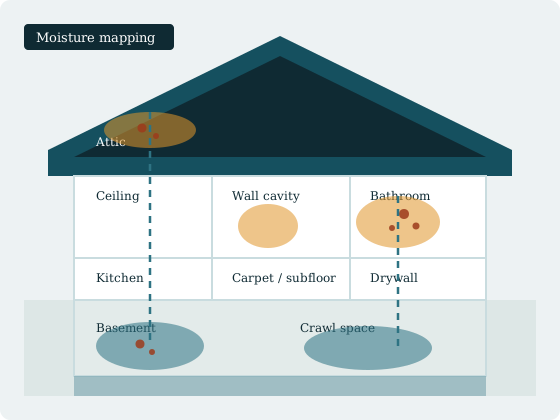
Inspection and moisture mapping
Moisture meters, thermal scanning and cavity inspection establish how far the problem extends and where the water came from. Readings on affected and unaffected materials give a documented baseline before anything is touched.
Containment under negative pressure
Polyethylene barriers, zipper access and negative air machines isolate the work area so spores are not carried into clean parts of the property. HVAC serving the area is isolated at the same time.
Removal of colonised material
Porous material that cannot be verified clean is cut back to sound substrate along a documented line and double-bagged out through a sealed route. Semi-porous surfaces are cleaned and abraded rather than removed.
HEPA filtration and cleaning
Air scrubbers run throughout the work and through final cleaning. Surfaces are HEPA vacuumed and treated with EPA-registered antimicrobial products appropriate to the substrate.
Structural drying
Air movers and low-grain refrigerant dehumidifiers dry framing, subfloor and masonry. Moisture content readings are logged daily and equipment stays until the numbers converge with an unaffected reference area.
Verification and documentation
A final visual inspection plus moisture readings confirm the area meets a dry standard. You receive the readings, the affected-area mapping, photographic records and the written scope of work.
Mold remediation services we provide in Marietta
Twenty specific services covering every assembly, material and water source we encounter across Marietta and Cobb County property.
Black Mold Removal
Black mold removal is the containment, physical removal and HEPA filtration of heavily colonised building materials, followed by correction of the moi…
Black Mold Removal in MariettaBasement Mold Remediation
Basement mold remediation addresses growth driven by below-grade moisture: foundation seepage, hydrostatic pressure, condensation on cool masonry and …
Basement Mold Remediation in MariettaCrawl Space Mold Removal
Crawl space mold removal treats growth on floor joists, subfloor sheathing, insulation and vapour barriers in the under-floor void. Marietta crawl spa…
Crawl Space Mold Removal in MariettaAttic Mold Remediation
Attic mold remediation treats growth on roof deck sheathing, rafters and insulation. In Marietta it is usually caused by warm moist air leaking from t…
Attic Mold Remediation in MariettaBathroom Mold Removal
Bathroom mold removal addresses growth caused by shower pan failure, cracked grout and sealant, supply or drain leaks, and inadequate exhaust ventilat…
Bathroom Mold Removal in MariettaKitchen Mold Removal
Kitchen mold removal handles growth from under-sink leaks, dishwasher and refrigerator supply line failures, and condensation in cabinet bases. Remedi…
Kitchen Mold Removal in MariettaCeiling Mold Removal
Ceiling mold removal addresses growth on ceiling drywall and plaster caused by roof leaks, upper-floor plumbing failures, HVAC condensate overflow and…
Ceiling Mold Removal in MariettaWall Mold Removal
Wall mold removal treats growth inside and on wall assemblies caused by plumbing leaks in the cavity, exterior water intrusion, rising moisture from a…
Wall Mold Removal in MariettaCarpet Mold Removal
Carpet mold removal covers contaminated carpet, pad, tack strip and the subfloor beneath. Pad is removed in virtually all cases because it retains wat…
Carpet Mold Removal in MariettaDrywall Mold Removal
Drywall mold removal is the controlled removal of colonised gypsum board, inspection of the cavity behind it, treatment of framing, and documented dry…
Drywall Mold Removal in MariettaWater Damage Mold Removal
Water damage mold removal combines water extraction, structural drying and mold remediation into one sequence. It applies when a burst pipe, appliance…
Water Damage Mold Removal in MariettaFlood Mold Remediation
Flood mold remediation treats growth following floodwater intrusion from storm runoff, creek overflow or groundwater. Floodwater is classified as gros…
Flood Mold Remediation in MariettaSewage Mold Remediation
Sewage mold remediation handles contamination from sewer line backups, drain overflows and toilet failures involving black water. All porous material …
Sewage Mold Remediation in MariettaWet Basement Mold Removal
Wet basement mold removal applies when water is actively entering a below-grade space through seepage, hydrostatic pressure, slab wicking or drainage …
Wet Basement Mold Removal in MariettaMoisture Mold Remediation
Moisture mold remediation addresses growth caused by chronic elevated humidity and condensation rather than a discrete leak. Causes include undersized…
Moisture Mold Remediation in MariettaMoldy Insulation Removal
Moldy insulation removal covers contaminated fibreglass batt, blown-in cellulose, mineral wool and duct lining in attics, crawl spaces, wall cavities …
Moldy Insulation Removal in MariettaMoldy Flooring Removal
Moldy flooring removal covers hardwood, engineered wood, laminate, luxury vinyl plank, tile and the subfloor beneath them. Material selection drives t…
Moldy Flooring Removal in MariettaMold Odor Removal
Mold odor removal locates and eliminates the source of musty smells rather than masking them. The odour comes from microbial volatile organic compound…
Mold Odor Removal in MariettaPost-Flood Mold Cleanup
Post-flood mold cleanup applies when growth has already established after a flood event, typically days or weeks later. Because colonisation has progr…
Post-Flood Mold Cleanup in MariettaStorm Damage Mold Remediation
Storm damage mold remediation addresses growth following wind-driven rain, roof breaches, tree impact and envelope failures. Water enters high in the …
Storm Damage Mold Remediation in MariettaWhy mold is a Marietta problem specifically
Local building stock and the Georgia climate produce a consistent set of failure modes.
Red clay that holds water
Cobb County soil drains slowly. After sustained rain it stays saturated against foundation walls for days, building hydrostatic pressure that finds cold joints, tie-rod holes and slab perimeters. That is why basements and crawl spaces here stay wet long after the yard looks dry.
High dew points for half the year
From late spring through early autumn, outdoor dew points sit high enough that any surface a few degrees cooler than the room will condense water out of the air. Crawl space joists, uninsulated ducts, basement masonry and north-facing exterior walls all qualify.
Crawl space foundations everywhere
A large share of Marietta housing sits on vented crawl spaces built when foundation vents were the entire moisture strategy. In this climate those vents frequently admit humid air that condenses on joists rather than drying them, and air from that void moves up into the living space continuously.
Housing stock spanning a century
Marietta has pre-war homes with original plumbing alongside recent construction with tight envelopes and oversized cooling. The first fails from leaks, the second from humidity. Diagnosing which is which before cutting anything is most of the work.
Not sure what you are looking at?
Send us to the property. We take readings, identify the source and tell you what the scope actually is — free, with no obligation.
Mold remediation cost in Marietta
Published ranges rather than a single headline number, because scope varies enormously. Your figure is confirmed after an on-site evaluation and a conversation about what the project involves.
Contained single area
$450 – $2,400
Typical project range
- One room or assembly
- Containment and HEPA filtration
- Material removal and antimicrobial treatment
- Drying and moisture verification
- Written documentation
Multi-area project
$2,400 – $6,500
Typical project range
- Two to four affected areas
- Negative air machines and ducting
- Insulation and flooring removal
- Daily moisture logging
- Source identification and reporting
Structural or whole-level
$6,500 – $14,000
Typical project range
- Extensive or multi-level contamination
- Phased containment zones
- Structural drying of framing and masonry
- Extended monitoring to dry standard
- Full documentation package
These are ranges, not quotes. The figure for your property depends on the affected area, how many assemblies are involved, the material types present, how long the moisture has been active and the drying time the structure requires. We give you a firm number after we have walked the property and taken readings.
Neighborhoods we serve across Marietta
Local coverage across the city, from the historic housing around the Square to newer construction on the city's edges.
- Downtown Marietta
- Marietta Square
- Forest Hills
- Whitlock
- Polk
- Dixie
- Austin
- Oakton
- Victory
- Fraiser
- Fort Hill–Roosevelt
- Barrett Green
- East Worthington
- Hardage Farm
- Manget
- Cherokee Heights
- Lewis Park
- Lemon
- Meeting Park
- Marietta Walk
- Kennesaw Avenue Area
- West Dixie Area
- Church Street–Cherokee Street Area
- Washington Avenue Area
- Northwest Marietta
- Whitlock Avenue Area
- Atlanta Street–Frasier Street Area
Mold remediation questions, answered
What is mold remediation?
Mold remediation is the controlled removal of mold-colonised building material and the correction of the moisture that caused it. It involves sealed containment under negative air pressure, HEPA filtration, removal of porous material that cannot be verified clean, antimicrobial treatment of structural surfaces, structural drying to a documented standard, and verification before the assembly is closed.
How fast can you get to a property in Marietta?
We respond around the clock across Marietta and Cobb County. Call and we will give you an arrival window, along with specific steps to limit further damage before we get there — usually isolating the water source, stopping foot traffic through the affected area and leaving the HVAC system off.
Is the on-site evaluation free?
Yes. We walk the affected areas, take moisture content readings, scan for concealed moisture, identify the likely water source and give you a written scope of work. There is no charge for that visit and no obligation to proceed with the work.
How quickly does mold grow after water damage?
Under typical Georgia indoor conditions, growth can establish on wet porous material within twenty-four to forty-eight hours. That window is why response time changes the outcome of a water loss more than any other single factor, and why drying should start the same day where possible.
Do you work with insurance carriers?
Yes. We document the loss with moisture readings, affected-area mapping, photographic evidence and a written scope, and we coordinate directly with your carrier or adjuster. Coverage decisions rest with your insurer and depend on your policy wording and the circumstances of the loss.
Will we need to move out during the work?
Most residential projects proceed with the household in place, because negative pressure containment keeps the work area isolated from the rest of the property. We recommend temporary relocation when containment has to cross a main circulation route, when HVAC must be shut down, or when an occupant has a diagnosed respiratory condition.
How do you prove the mold is actually gone?
By measurement rather than appearance. We record moisture content readings on previously affected materials against an unaffected reference area in the same building, confirm them with a visual inspection of all remediated surfaces, and issue that documentation to you. Work is complete when the readings converge, not on a fixed calendar date.
Do you remove mold without fixing the leak?
No. Remediating colonised material without correcting the water source produces a property that looks finished and fails again in the same place. Identifying the moisture source is part of every scope. Where the repair belongs to another trade, such as a roofer or plumber, we document it clearly so the sequence is right.
Call for a free on-site evaluation
We walk the property, take moisture readings, identify the source and give you a written scope with a firm figure. Open 24 hours for emergency mold and water response across Marietta.
Marietta Mold Remediation · 508 Roswell St NE, Marietta, GA 30060