
Wet Basement Mold Removal in Marietta, GA
An actively wet basement is a different job from a damp one. Water is still arriving, so extraction and source control come before any remediation decision is worth making.
What is wet basement mold removal?
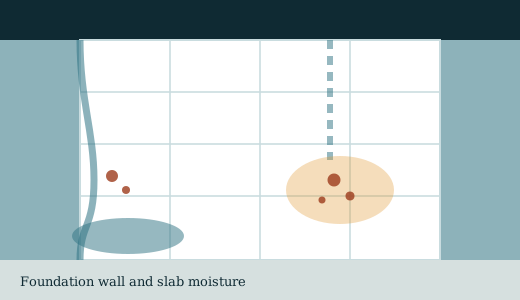
Wet basement mold removal applies when water is actively entering a below-grade space through seepage, hydrostatic pressure, slab wicking or drainage failure. The sequence is extraction first, then source identification, then removal of colonised material, then sustained drying and humidity control to prevent recurrence.
Cobb County's red clay soil is dense and drains slowly. After a sustained rain it holds water against foundation walls and builds hydrostatic pressure that finds the path of least resistance: a cold joint at the footing, a tie-rod hole, a crack in the wall, or the slab perimeter. That is why a basement can stay wet for days after the rain has stopped and the yard looks dry.
Extraction comes first, because every hour of standing water extends wicking into adjacent material. Then we identify the entry point, which usually involves tracing staining and efflorescence patterns on the wall, checking exterior grading and downspout discharge, and assessing whether the sump system is functioning and correctly discharged. These are frequently the actual fix, and they fall outside remediation scope — but you need to know about them before you spend money on finishes.
Colonised material comes out after the water stops. Where the basement is finished, the work overlaps with basement mold remediation, with cut lines above the wetted height and insulation removal from the affected bays. Where it is unfinished, scope is usually limited to stored contents, lower framing and the slab itself.
Signs you need wet basement mold removal
- Water appearing on the basement floor during or after heavy rain
- Efflorescence, chalky white deposits or dark tide lines on foundation walls
- A sump pump running frequently or failing to keep up
- Damp or cool slab underfoot even when no water is visible
- Rust forming on the base of appliances, shelving or metal studs
- Persistent musty odour that is worse after rainfall
How we handle wet basement mold removal in Marietta
Emergency extraction
Standing water is removed with portable and truck-mounted equipment to stop further wicking into adjacent material.
Entry point diagnosis
Wall staining patterns, exterior grading, downspout discharge and sump performance are assessed to locate the water path.
Material removal
Colonised drywall, insulation, flooring and stored contents are removed under containment and bagged out.
Masonry and slab treatment
Foundation walls and slab are cleaned, HEPA vacuumed and treated with EPA-registered antimicrobials.
Sustained drying
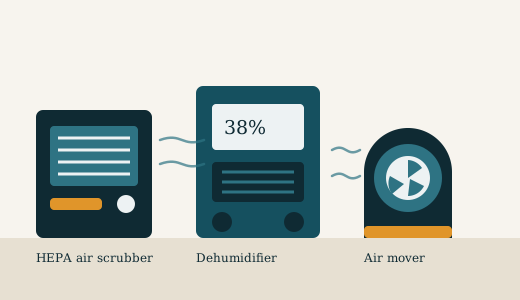
Low-grain refrigerant dehumidification dries masonry and slab, with readings logged until targets hold without equipment.
What gets removed and what gets saved
| Material | Typical outcome | Reason |
|---|---|---|
| Standing water | Extracted immediately | Delay widens the affected area measurably every hour. |
| Finished wall materials | Removed above water line | Gypsum wicks well above the water's physical height. |
| Foundation wall and slab | Cleaned and dried | Masonry releases moisture slowly but recovers fully with sustained drying. |
| Stored contents on the floor | Assessed, mostly removed | Cardboard, fabric and paper absorb and hold water and spores. |
Moisture source correction is part of the scope
Every project includes identifying the water that caused the growth. Remediating colonised material without correcting the source produces a clean property that fails again in the same place. Where the correction falls to another trade, we document it precisely so the sequence is right.
Wet Basement Mold Removal cost in Marietta
Ranges below reflect typical completed projects. Final pricing is confirmed after an on-site evaluation and a conversation about scope.
Active seepage response
$1,800 – $3,800
Typical project range
- Extraction and stabilisation
- Source assessment
- Targeted material removal
- Below-grade drying
Finished basement affected
$3,800 – $7,000
Typical project range
- Wall and flooring removal
- Full containment remediation
- Masonry treatment
- Extended drying
Recurrent / whole-basement
$7,000 – $10,000
Typical project range
- Repeat intrusion history
- Complete material removal
- Structural drying
- Humidity control verification
These are ranges, not quotes. The figure for your property depends on the affected area, how many assemblies are involved, the material types present, how long the moisture has been active and the drying time the structure requires. We give you a firm number after we have walked the property and taken readings.
Wet Basement Mold Removal questions
Why is my basement wet when it has not rained for days?
Clay soil holds water long after surface conditions look dry, and that saturated soil continues to press against the foundation. Water also moves slowly through masonry, so a wall can keep releasing moisture into the space for days. A sump system that is undersized or discharging too close to the foundation extends this further.
Will waterproofing fix the mold problem?
Waterproofing addresses the water path, which is essential, but it does nothing about material already colonised. The correct sequence is to stop the water, remove and treat what has been affected, dry the space, and then evaluate whether a drainage or waterproofing solution is needed to keep it that way.
Can I store things in the basement afterwards?
Yes, with changes. Keep contents off the slab on shelving or pallets, avoid cardboard in favour of sealed plastic containers, and maintain relative humidity below the growth threshold with a properly sized dehumidifier. We document the target humidity and what it takes to hold it.
How long does a wet basement take to dry properly?
Framing and drywall usually reach target within three to five days. Masonry and slab take longer because dense materials release moisture slowly, often seven to fourteen days under sustained dehumidification. We verify with readings rather than removing equipment on a schedule.
Related mold services
Moisture problems rarely stay inside one assembly. These are the services most often carried out alongside wet basement mold removal.
- Basement Mold RemediationBelow-grade space in Cobb County sits against red clay that holds water long after rain stop…
- Flood Mold RemediationFloodwater is not clean water that happened to arrive in volume. It carries soil, fertiliser…
- Moisture Mold RemediationSome properties never had a leak. Growth appears because indoor humidity sits too high for t…
- Crawl Space Mold RemovalAir in a vented crawl space moves upward into the living space. Growth on joists and subfloo…
View all 20 mold remediation services
Get a firm figure for your property
We walk the affected areas, take moisture readings and give you a written scope with pricing before any work begins.