
Basement Mold Remediation in Marietta, GA
Below-grade space in Cobb County sits against red clay that holds water long after rain stops. That hydrostatic load, plus warm humid air meeting cool foundation walls, is what grows mold in Marietta basements.
What is basement mold remediation?
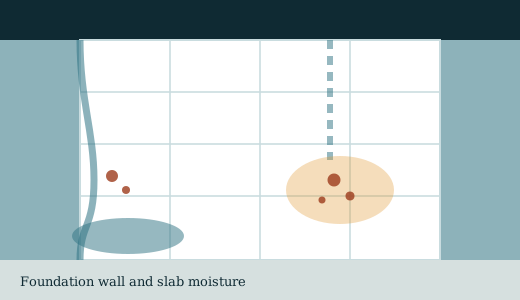
Basement mold remediation addresses growth driven by below-grade moisture: foundation seepage, hydrostatic pressure, condensation on cool masonry and unvented humidity. The work involves opening finished wall assemblies, removing colonised framing bottom plates and insulation, drying the slab and masonry, then controlling humidity so the basement stays below the growth threshold.
A finished basement hides its own problem. Studs sit on a treated bottom plate against a slab, batt insulation fills the cavity, and drywall closes it in. When moisture migrates through the foundation wall or wicks up through the slab, the cavity becomes a sealed, dark, humid chamber. Growth is often well established before any staining shows on the painted face.
We start by establishing whether the water is coming through the wall, up through the slab, down from a plumbing or HVAC source above, or condensing out of the air. Each of those has a different repair path, and remediating without that answer guarantees a repeat. Thermal scanning and pin and pinless meter readings on the drywall, bottom plate and slab edge give us that picture quickly.
Unfinished basements are more straightforward but not automatically safer. Exposed joists, stored cardboard, and fibrous ductwork insulation all support growth when relative humidity sits above roughly sixty percent through a Georgia summer. If your basement has standing water or an active seepage event, start with wet basement mold removal, which deals with extraction and drying first.
Signs you need basement mold remediation
- Musty odour strongest at the bottom of the basement stairs
- White chalky efflorescence or dark tide lines on foundation walls
- Baseboard or drywall darkening in the lowest four inches of the wall
- Carpet or pad that feels cool and damp against the slab
- Condensation beading on supply ducts, pipes or the foundation wall in summer
- Warped or lifting vinyl plank flooring near an exterior wall
How we handle basement mold remediation in Marietta
Source classification
We determine whether moisture is seepage, slab wicking, overhead plumbing or condensation before any demolition begins.
Cavity opening
Finished walls are opened along a documented cut line inside containment so the stud bay, plate and insulation can be assessed.
Removal and cleaning
Colonised drywall and batt insulation are bagged out; framing and masonry are HEPA vacuumed and treated.
Below-grade drying
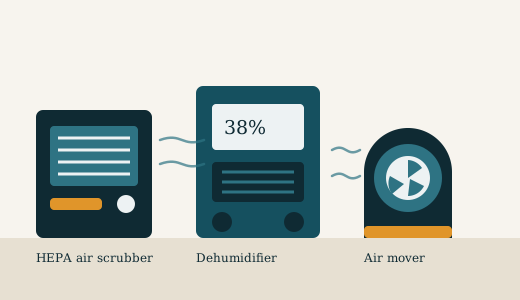
Low-grain refrigerant dehumidifiers and directed air movers dry masonry, slab edge and framing to documented targets.
Humidity control plan
We set and verify a sustainable relative humidity target and document what has to change to hold it.
What gets removed and what gets saved
| Material | Typical outcome | Reason |
|---|---|---|
| Finished drywall below grade | Removed to a cut line | Gypsum wicks slab and wall moisture upward and will re-colonise. |
| Batt insulation in stud bays | Removed | Fibreglass holds moisture against the foundation and hides growth entirely. |
| Treated bottom plate | Usually cleaned | Pressure-treated lumber resists decay and can often be abraded and retained. |
| Carpet and pad on slab | Removed | Pad acts as a reservoir; backing adhesive supports growth after one wetting. |
Moisture source correction is part of the scope
Every project includes identifying the water that caused the growth. Remediating colonised material without correcting the source produces a clean property that fails again in the same place. Where the correction falls to another trade, we document it precisely so the sequence is right.
Basement Mold Remediation cost in Marietta
Ranges below reflect typical completed projects. Final pricing is confirmed after an on-site evaluation and a conversation about scope.
Partial wall assembly
$1,500 – $3,400
Typical project range
- One or two stud bays opened
- Containment and HEPA filtration
- Insulation and drywall removal
- Dehumidification
Finished basement section
$3,400 – $6,200
Typical project range
- Full wall runs and flooring
- Multiple drying units
- Framing treatment
- Humidity control verification
Whole basement
$6,200 – $9,000
Typical project range
- Complete finished level
- Phased containment
- Flooring, insulation and ceiling work
- Extended monitoring
These are ranges, not quotes. The figure for your property depends on the affected area, how many assemblies are involved, the material types present, how long the moisture has been active and the drying time the structure requires. We give you a firm number after we have walked the property and taken readings.
Basement Mold Remediation questions
Why does mold keep returning to my Marietta basement every summer?
Georgia summer air holds a lot of moisture. When warm humid air enters a basement and meets masonry that stays near ground temperature, water condenses on those surfaces. If relative humidity in the space sits above roughly sixty percent for extended periods, growth resumes regardless of how well the previous remediation was performed. Sustained dehumidification is the fix.
Should I remove basement carpet before remediation?
Leave it in place until we inspect. The carpet and pad often tell us where moisture is entering, and removing it early destroys that evidence. If it has been wet more than a couple of days, it will come out during remediation anyway, inside containment, so spores are not dispersed through the house.
Does a dehumidifier alone solve a basement mold problem?
A dehumidifier controls airborne humidity but does nothing about liquid water entering through the foundation, and nothing about material already colonised. It is an essential part of the long-term control plan, not a remediation method on its own.
Can you work around a finished basement I do not want demolished?
We always cut the minimum defensible line. Where growth is confined to the lower portion of a wall, a flood-cut at a set height preserves the upper drywall and the ceiling. We mark proposed cut lines before starting so you know exactly what is coming out.
Related mold services
Moisture problems rarely stay inside one assembly. These are the services most often carried out alongside basement mold remediation.
- Wet Basement Mold RemovalAn actively wet basement is a different job from a damp one. Water is still arriving, so ext…
- Moisture Mold RemediationSome properties never had a leak. Growth appears because indoor humidity sits too high for t…
- Wall Mold RemovalWhat shows on the painted face is the smallest part of the problem. The stud bay behind it h…
- Flood Mold RemediationFloodwater is not clean water that happened to arrive in volume. It carries soil, fertiliser…
View all 20 mold remediation services
Get a firm figure for your property
We walk the affected areas, take moisture readings and give you a written scope with pricing before any work begins.