
Bathroom Mold Removal in Marietta, GA
Surface growth on grout is cosmetic. Growth that returns within weeks of cleaning means water is getting behind the tile and sitting in the wall cavity or subfloor.
What is bathroom mold removal?
Bathroom mold removal addresses growth caused by shower pan failure, cracked grout and sealant, supply or drain leaks, and inadequate exhaust ventilation. Work covers opening affected wall cavities and subfloor, removing colonised gypsum and backer, treating framing, drying the assembly, and correcting the ventilation that allowed humidity to persist.
Bathrooms produce more water vapour per square foot than any other room in a Marietta home, and most have a single exhaust fan that is either undersized, unducted to the exterior, or never switched on long enough to clear the load. That alone will grow mold on ceilings and upper wall corners. It is the easiest version of the problem to solve.
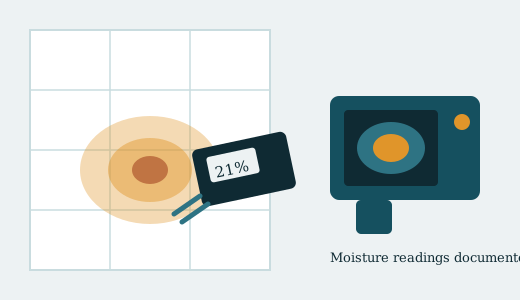
The harder version is concealed. A shower pan that has split at the drain flange, a failed sealant joint at the curb, or a supply line weeping behind the valve puts water into the stud bay and under the tile bed. By the time staining appears on the opposite side of the wall or on a ceiling below, the cavity has been wet for a long period. We confirm this with meter readings taken through the tile joint and at the base of the wall on both faces before proposing any demolition.
Where a shower or tub surround has to come out, we cut to the nearest sound joint and remove gypsum or cement backer that has been saturated. Framing is cleaned and treated. Subfloor is assessed for delamination at the pan perimeter, which is where rot is typically found. Related work often continues into ceiling mold removal in the room below.
Signs you need bathroom mold removal
- Growth that returns on grout and sealant within weeks of cleaning
- Staining on the ceiling of the room directly below a bathroom
- Loose, hollow-sounding or cracked tiles in the shower surround
- Peeling paint or soft drywall adjacent to the tub or shower
- A soft or springy floor near the toilet base or shower curb
- An exhaust fan that does not clear mirror fog within ten minutes
How we handle bathroom mold removal in Marietta
Leak localisation
Readings at the wall base, opposite face and ceiling below establish whether water is behind the tile or purely surface humidity.
Room containment
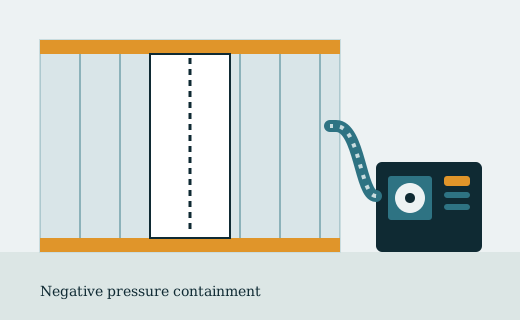
The bathroom is isolated with a sealed barrier and negative air before tile or drywall is disturbed.
Assembly opening
Saturated gypsum, cement backer and tile are removed to the nearest sound joint and bagged inside containment.
Framing and subfloor treatment
Studs, plates and subfloor are HEPA vacuumed, treated, and assessed for delamination at the pan perimeter.
Drying and ventilation fix
The cavity is dried to documented targets and exhaust ventilation is corrected so humidity clears properly.
What gets removed and what gets saved
| Material | Typical outcome | Reason |
|---|---|---|
| Grout and sealant joints | Cleaned or renewed | Surface growth is removable; failed sealant is replaced to stop re-entry. |
| Gypsum behind tile | Removed | Standard drywall behind a wet area is saturated and cannot be dried in place. |
| Cement backer board | Assessed case by case | Backer survives wetting but is removed where growth is on the mesh face. |
| Subfloor at pan perimeter | Removed where delaminated | Plywood that has lost ply bond no longer supports the pan correctly. |
Moisture source correction is part of the scope
Every project includes identifying the water that caused the growth. Remediating colonised material without correcting the source produces a clean property that fails again in the same place. Where the correction falls to another trade, we document it precisely so the sequence is right.
Bathroom Mold Removal cost in Marietta
Ranges below reflect typical completed projects. Final pricing is confirmed after an on-site evaluation and a conversation about scope.
Surface and ventilation
$600 – $1,200
Typical project range
- Surface treatment of affected finishes
- HEPA cleaning
- Exhaust performance assessment
- Sealant renewal
Wall cavity remediation
$1,200 – $2,400
Typical project range
- Tile and backer removal
- Stud bay treatment
- Cavity drying
- Moisture verification
Shower assembly and subfloor
$2,400 – $3,500
Typical project range
- Pan perimeter subfloor work
- Full surround removal
- Structural treatment
- Extended drying
These are ranges, not quotes. The figure for your property depends on the affected area, how many assemblies are involved, the material types present, how long the moisture has been active and the drying time the structure requires. We give you a firm number after we have walked the property and taken readings.
Bathroom Mold Removal questions
Why does mold come back on my shower grout after I clean it?
Grout is porous and the joint behind it stays damp if water passes the sealant line or if the room never dries between uses. Cleaning removes what you can see while the moisture source continues. Lasting results require sealing the water path and getting the room to dry within a reasonable window after use.
How do I know if water is getting behind the tile?
Loose or hollow-sounding tiles, staining on the far side of the wall, or a ceiling mark in the room below are the reliable indicators. Meter readings taken through a grout joint confirm it quickly without opening anything. We do that assessment before recommending any demolition.
Does running the bathroom fan longer actually help?
It does, provided the fan is sized correctly and ducted to the outside rather than into the attic. Running it for fifteen to twenty minutes after a shower clears the moisture load. A fan that terminates in the attic simply moves the problem overhead, where it causes attic sheathing growth instead.
Will the bathroom be unusable during the work?
A surface-level project leaves the room usable the same day. Where the shower surround or subfloor is opened, that bathroom is out of service for the duration, typically two to four days. We confirm the expected downtime before starting so you can plan around it.
Related mold services
Moisture problems rarely stay inside one assembly. These are the services most often carried out alongside bathroom mold removal.
- Ceiling Mold RemovalA ceiling stain is the end of the water's journey, not the start. The source is often severa…
- Wall Mold RemovalWhat shows on the painted face is the smallest part of the problem. The stud bay behind it h…
- Drywall Mold RemovalDrywall is paper on both faces of a gypsum core. Paper is food and gypsum holds water, which…
- Moisture Mold RemediationSome properties never had a leak. Growth appears because indoor humidity sits too high for t…
View all 20 mold remediation services
Get a firm figure for your property
We walk the affected areas, take moisture readings and give you a written scope with pricing before any work begins.