
Wall Mold Removal in Marietta, GA
What shows on the painted face is the smallest part of the problem. The stud bay behind it has no airflow and no light, which makes it the most reliable place in a house for mold to establish.
What is wall mold removal?
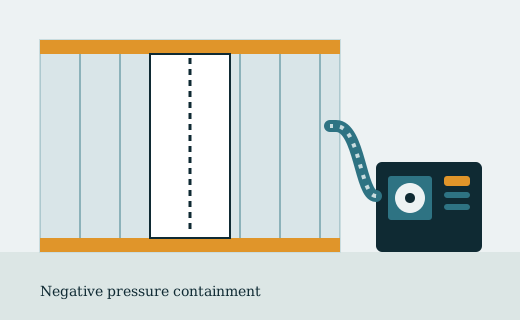
Wall mold removal treats growth inside and on wall assemblies caused by plumbing leaks in the cavity, exterior water intrusion, rising moisture from a slab and interior condensation. Work includes opening the cavity along a controlled cut line, removing colonised gypsum and insulation, treating framing, and drying the assembly before closure.
Wall cavities fail quietly. A pinhole in a copper supply line, a drain connection that weeps at a joint, or window flashing that directs water into the sheathing all put moisture into a closed stud bay. The gypsum absorbs it, the batt insulation holds it, and the cavity stays at elevated humidity for months. By the time you see bubbling paint or a dark patch, the assembly has been colonised front to back.
Our cut lines are deliberate. We open an inspection port first, confirm the vertical and horizontal extent with readings and visual assessment, and then mark a cut at a defensible boundary — usually a stud centre and a consistent height so the repair is clean. Cutting wider than necessary costs you money and cutting narrower than the contamination leaves the problem in the wall.
Exterior walls add a layer. Where water has come from outside, the sheathing and the weather barrier behind the siding are part of the assessment, because closing the wall without resolving that path means a repeat within a season. Interior partition walls are simpler and usually trace to a plumbing or appliance source.
Signs you need wall mold removal
- Bubbling, blistering or peeling paint in a defined patch
- A dark or shadowed area on the wall that does not wipe away
- Cool or damp drywall to the touch compared with surrounding wall
- Baseboard separating, cupping or showing dark staining at its top edge
- A musty smell that is strongest at an electrical outlet on that wall
- Soft drywall that gives under moderate finger pressure
How we handle wall mold removal in Marietta
Cavity assessment
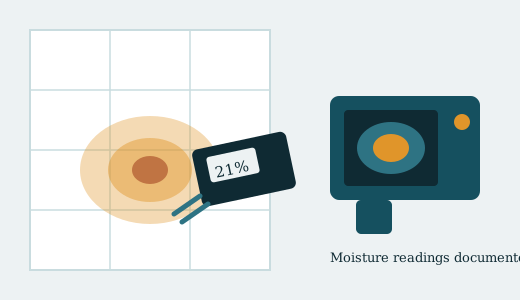
An inspection opening plus pin and pinless readings establish how far growth and moisture extend inside the assembly.
Cut line marking
We mark the proposed removal boundary at stud centres and a consistent height, and confirm it with you before cutting.
Controlled removal
Gypsum and insulation are removed inside containment, bagged, and routed out without crossing clean areas.
Framing remediation
Studs, plates and sheathing are HEPA vacuumed, abraded where growth is embedded, and antimicrobial treated.
Assembly drying
Directed airflow into open bays plus dehumidification brings framing to documented moisture targets before closure.
What gets removed and what gets saved
| Material | Typical outcome | Reason |
|---|---|---|
| Drywall face | Removed to cut line | Colonisation runs through the paper and gypsum core, not just the surface. |
| Cavity insulation | Removed | Batts hold moisture, conceal growth, and lose thermal value once wet. |
| Studs and plates | Cleaned and treated | Framing lumber carries surface growth that abrasion and HEPA vacuuming resolve. |
| Exterior sheathing | Assessed individually | OSB that has swollen at the edges is replaced; sound sheathing is treated. |
Moisture source correction is part of the scope
Every project includes identifying the water that caused the growth. Remediating colonised material without correcting the source produces a clean property that fails again in the same place. Where the correction falls to another trade, we document it precisely so the sequence is right.
Wall Mold Removal cost in Marietta
Ranges below reflect typical completed projects. Final pricing is confirmed after an on-site evaluation and a conversation about scope.
Single wall section
$700 – $1,700
Typical project range
- One to two stud bays
- Containment and HEPA filtration
- Insulation and board removal
- Cavity drying
Full wall run
$1,700 – $3,200
Typical project range
- Complete wall length
- Framing treatment
- Multiple drying units
- Moisture logging
Multiple walls / exterior assembly
$3,200 – $4,500
Typical project range
- Several walls or an exterior assembly
- Sheathing assessment
- Extended containment
- Full verification
These are ranges, not quotes. The figure for your property depends on the affected area, how many assemblies are involved, the material types present, how long the moisture has been active and the drying time the structure requires. We give you a firm number after we have walked the property and taken readings.
Wall Mold Removal questions
How can I tell if mold is inside the wall without opening it?
Meter readings taken across the wall face identify elevated moisture without damage, and thermal imaging highlights temperature anomalies that often correspond to wet areas. Those two together are reliable enough to decide where to make an inspection opening, which is a small cut rather than a demolition.
How much of the wall has to come out?
As little as the contamination allows. We open an inspection port, confirm the extent, then cut at a defensible boundary at stud centres. That typically means removing somewhat more than the visible stain but far less than an entire wall. You see and approve the marked line before we cut.
Can the insulation be dried and left in the wall?
Fibreglass batt that has been wet for more than a short period is removed. Even after it dries, it has been a growth substrate and its thermal performance is compromised by the compression and settling that wetting causes. Replacing it is routine and inexpensive relative to the rest of the work.
What happens to the wall after remediation?
We leave the cavity open, dry and verified. Reinstating drywall, texture and paint is finish carpentry rather than remediation, and we will tell you clearly where our scope ends so there is no gap between trades.
Related mold services
Moisture problems rarely stay inside one assembly. These are the services most often carried out alongside wall mold removal.
- Drywall Mold RemovalDrywall is paper on both faces of a gypsum core. Paper is food and gypsum holds water, which…
- Black Mold RemovalDark staining on drywall, framing or subfloor almost always means a moisture source has been…
- Moisture Mold RemediationSome properties never had a leak. Growth appears because indoor humidity sits too high for t…
- Basement Mold RemediationBelow-grade space in Cobb County sits against red clay that holds water long after rain stop…
View all 20 mold remediation services
Get a firm figure for your property
We walk the affected areas, take moisture readings and give you a written scope with pricing before any work begins.