
Moisture Mold Remediation in Marietta, GA
Some properties never had a leak. Growth appears because indoor humidity sits too high for too long, and surfaces stay cool enough for water to condense out of the air onto them.
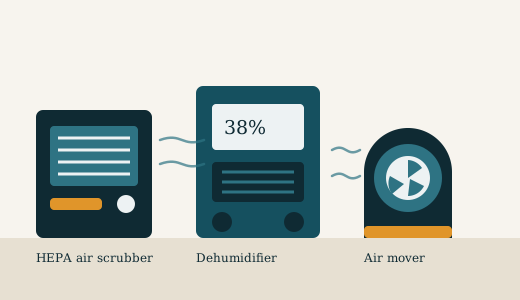
What is moisture mold remediation?
Moisture mold remediation addresses growth caused by chronic elevated humidity and condensation rather than a discrete leak. Causes include undersized or oversized HVAC, poor ventilation, uninsulated cold surfaces and vapour migration. Work combines remediation of affected materials with diagnosis and correction of the humidity conditions that produced them.
This is the case where no water ever visibly arrived. Growth appears on closet walls behind furniture, on north-facing exterior walls, around window frames, on supply registers, or on the underside of an uninsulated duct. The common factor is a surface that stays below the dew point of the surrounding air long enough for liquid water to form on it.
Georgia's climate drives this hard. Outdoor dew points sit high for months, and an air conditioning system that is oversized for the house cools the air quickly without running long enough to remove moisture from it. The result is a cool house that is still humid — comfortable to walk into, and ideal for growth on any surface that sits a few degrees cooler than the room.
Remediation here is often the smaller half of the project. We remove and treat what is affected, then measure: relative humidity and temperature across the property, surface temperatures on the problem walls, HVAC runtime behaviour, and ventilation performance. Without that diagnosis, you clean a wall and watch it return the following summer.
Signs you need moisture mold remediation
- Growth on exterior-facing walls behind furniture or inside closets
- Condensation on windows, supply registers or exposed ductwork
- A house that feels cool but clammy during summer
- Musty odour with no identifiable leak or water event
- Spotting on leather goods, luggage or stored fabric
- Growth recurring in the same place each summer after cleaning
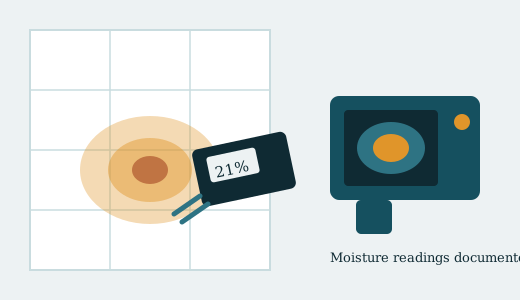
How we handle moisture mold remediation in Marietta
Humidity and dew point survey
Relative humidity, temperature and surface temperatures are measured across the property to locate condensation conditions.
Affected material remediation
Colonised finishes and contents are removed or cleaned under containment with HEPA filtration.
Surface and cavity treatment
Walls, framing and affected assemblies are HEPA vacuumed and treated with EPA-registered antimicrobials.
System and ventilation assessment
HVAC runtime, duct insulation, exhaust ventilation and air sealing are evaluated against the measured conditions.
Control plan and verification
A documented humidity target is set and verified to hold, with the specific corrections required to maintain it.
What gets removed and what gets saved
| Material | Typical outcome | Reason |
|---|---|---|
| Finished wall surfaces | Cleaned where surface only | Condensation growth is often superficial and responds to cleaning. |
| Wall cavity insulation | Removed where cavity moisture confirmed | Vapour migration into the cavity makes batts a reservoir. |
| Soft contents and stored fabric | Cleaned or removed | Porous contents hold spores and reseed a cleaned room. |
| Duct insulation and boots | Replaced where wet | Condensation on uninsulated metal saturates the surrounding lining. |
Moisture source correction is part of the scope
Every project includes identifying the water that caused the growth. Remediating colonised material without correcting the source produces a clean property that fails again in the same place. Where the correction falls to another trade, we document it precisely so the sequence is right.
Moisture Mold Remediation cost in Marietta
Ranges below reflect typical completed projects. Final pricing is confirmed after an on-site evaluation and a conversation about scope.
Localised condensation
$900 – $2,100
Typical project range
- One or two affected areas
- Surface remediation
- HEPA cleaning
- Humidity measurement
Multi-area humidity problem
$2,100 – $4,100
Typical project range
- Several rooms affected
- Cavity remediation where needed
- Content treatment
- Ventilation assessment
Whole-property control
$4,100 – $6,000
Typical project range
- Property-wide remediation
- HVAC and duct evaluation
- Dedicated dehumidification
- Verified humidity target
These are ranges, not quotes. The figure for your property depends on the affected area, how many assemblies are involved, the material types present, how long the moisture has been active and the drying time the structure requires. We give you a firm number after we have walked the property and taken readings.
Moisture Mold Remediation questions
Can mold grow without any leak at all?
Yes, and it is common in this climate. If relative humidity stays above roughly sixty percent and a surface sits near or below the dew point, water condenses onto that surface and supports growth. No plumbing failure is required, which is why these cases often go undiagnosed for years.
Why is growth worse in my closets?
Closets have no air circulation, usually sit against an exterior wall, and are packed with porous contents. The lack of air movement lets the surface temperature drop a few degrees below the rest of the room, which is enough to push it under the dew point during humid months.
Would a bigger air conditioner solve this?
Usually the opposite. An oversized system satisfies the thermostat quickly and shuts off before it has run long enough to dehumidify. Long, lower-capacity run cycles remove far more moisture. Correct sizing, or a dedicated dehumidifier working alongside the system, is the better path.
What humidity level should I actually aim for?
Holding indoor relative humidity in the range of forty-five to fifty-five percent keeps most surfaces above the condensation threshold without creating dryness problems. We measure your specific conditions and document the target for your property rather than quoting a generic number.
Related mold services
Moisture problems rarely stay inside one assembly. These are the services most often carried out alongside moisture mold remediation.
- Basement Mold RemediationBelow-grade space in Cobb County sits against red clay that holds water long after rain stop…
- Crawl Space Mold RemovalAir in a vented crawl space moves upward into the living space. Growth on joists and subfloo…
- Attic Mold RemediationDark sheathing on the north slope of a roof deck is a ventilation and warm-air problem, not …
- Mold Odor RemovalA musty smell is information. It means an active or recently active colony is giving off mic…
View all 20 mold remediation services
Get a firm figure for your property
We walk the affected areas, take moisture readings and give you a written scope with pricing before any work begins.